We Weren’t Ready for ChatGPT. Are We Ready for What’s Next?
A New Epoch
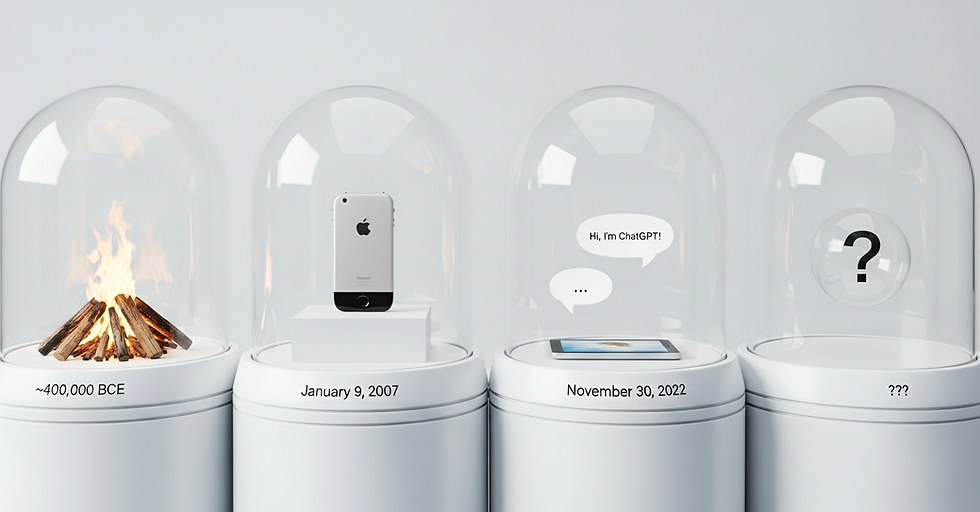
November 30, 2022.
The day technology changed our lives forever.
Before this, the release of the iPhone on January 9, 2007 was the last time society felt such a seismic technological shift. The arrival of Generative AI was different.
It was free.
It was accessible.
And it would ignite one of the most chaotic yet transformative periods in modern history.
From Science Fiction to Reality
For decades, artificial intelligence belonged to the realm of science fiction. We imagined humanoid robots who could speak and helpful household assistants like Rosie from The Jetsons. Even I, an AI professional, indulged in that fantasy, I purchased an Amazon Astro robotic dog simply because I love technology.
Yet despite years of building AI systems and leading AI initiatives, I never could have predicted what would happen when people discovered that technology could understand them in plain English overnight.
The first time I sat down with ChatGPT, it was an emotional experience.
In that moment, I wasn’t an AI professional optimizing AI for business or patient needs. I was a consumer and a fan.
I called my young daughter over and said “look at this.” I thought about the world she will inherit.
But while my response as a consumer was excitement, my professional response would be more complex.
The Double-Edged Sword of ChatGPT
ChatGPT’s release to the public was a double-edged sword. Everyone had access before we understood how to use it or what it would do to society.
The Rush to Market
OpenAI, the parent company of ChatGPT, made a strategic decision to release to the public. It gave them “first mover advantage” and it has paid off, to many people, ChatGPT is AI.
They may have unknowingly launched the biggest technology experiment in history, while simultaneously collecting history’s most valuable data set on technology use.
Within days, millions of people were experimenting with AI capabilities that even experts did not fully understand. Researchers, ethicists, educators, and policymakers were blindsided.
If “ask for forgiveness, not permission” were a person, it would be OpenAI.
But innovation often requires the courage to move, and by giving AI to the public OpenAI simultaneously created unprecedented opportunity with a bit of chaos baked in.
A Society Recalibrating
GenAI ushered in both an existential crisis: who am I and what am I here for, as well as the democratization of AI.
For so long, AI was a niche discipline popular in science and medicine where its purpose was to improve human lives. But GenAI delivered through ChatGPT and now other popular AIs like Claude and Gemini has reframed what AI is and what it should be.
Educational Evolution
In education, AI generates content challenging the traditional value of academic degrees, giving students instant access to answers. At the same time, teachers have more tools to develop content. But how do we balance accessibility with academic integrity?
Creative Transformation
AI creates art, videos, and films. Now we ask: should we allow it to? Artists now have the technology to prototype their ideas, but with the trade-off that its outputs challenge their own creative value.
Professional Adaptation
Content creators, programmers, and writers face questions about their evolving roles. Some see AI as a threat to their livelihoods, while others embrace it as a powerful collaborator that amplifies their capabilities.
Regulatory Balance
Governments worldwide scramble to regulate technology they’re still learning about. The challenge: how do we protect against harm while preserving innovation and the benefits AI brings to society?
Environmental Impact
And we can’t ignore the environmental costs. Data centers require massive energy and water resources. The earth’s resources aren’t unlimited.
Behavioral Consequences
We can’t ignore the behavioral costs. Psychologists are flagging overdependence on AI tools for companionship among teenagers and young adults. In a world where social media adoption led to increased loneliness, this isn’t a side effect of AI that we can ignore.
Out of challenges comes opportunity. The challenges are many, so are the opportunities.
Humanity’s Next “Fire”
We figured out how to make fire. I’m sure we burned a lot of things down before we learned how to control it. We left behind nomadic civilizations in exchange for cities. We launched rockets and went to the moon and beyond, but not without casualties.
AI may very well be another transition point in history. We are currently in the "burning things down" phase while simultaneously trying to build the world's largest, most complex fireplace.
When future humans study us in history books, or more likely on digital interfaces with their AI beside them, they will learn that November 30, 2022 was the day humanity entered a new epoch. We became AI-enabled.
Transitions are never easy to live through.
But what awaits us on the other side?
Join the Conversation
"AI is the tool, but the vision is human." — Sophia B.
👉 For weekly insights on navigating our AI-driven world, subscribe to AI & Me:
Let’s Connect
I’m exploring how generative AI is reshaping storytelling, science, and art — especially for those of us outside traditional creative industries.
About the Author
Sophia Banton works at the intersection of AI strategy, communication, and human impact. With a background in bioinformatics, public health, and data science, she brings a grounded, cross-disciplinary perspective to the adoption of emerging technologies.
Beyond technical applications, she explores GenAI’s creative potential through storytelling and short-form video, using experimentation to understand how generative models are reshaping narrative, communication, and visual expression.


