Will AI Take Us Back to Eden?
Updated: Aug 12, 2025

"And man was placed in the garden of Eden to tend and keep it." - The Book of Genesis
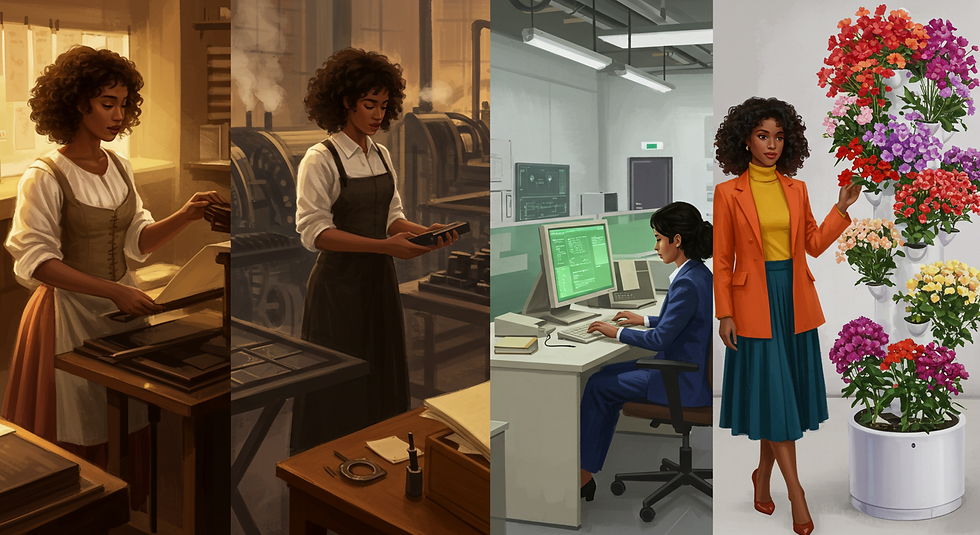
Behind every question, every prompt, every keystroke lies mankind's hope that AI will take us back to a place where work feels effortless, where knowledge flows freely, and where existence is not a struggle for sustenance but a canvas for purpose. That place is what we imagine when we think of Eden.
AI offers something no previous technology does. It frees us from mental work. Industrialization changed how we labor; AI changes how we think, sometimes doing the thinking for us. And so we prompt, believing that maybe this time will be different. Maybe this time technology will make life easier and deliver us to the promised land.
But what exactly is "easier"?
From Innocence to Survival : The Long Road Back to Eden
"When I became a man I put away childish things, including the fear of childishness." - C.S. Lewis
As children, the hardest thing we have to do is listen to our parents. The harsh reality of survival is hidden from us as we eat, play, laugh, and consume. But adulthood reveals that childhood was myth and hardship is reality.
We are sent into the world to feed ourselves, sustain ourselves, and fight not to disappear into the background of civilization. Even as AI takes on intellectual labor, the deeper struggle remains: competing for resources, recognition, and relevance.
Some adopt Darwinian principles, embracing survival of the fittest. Competition replaces playgrounds. Now only the fittest can eat. The abundance of Eden became a scarcity of resources.
And so we toil physically and intellectually to survive, perpetually hoping that the next technology will make our work easier. Not just to have more free time, but to reclaim our humanity: to have more time for connection, creativity, and authentic human experience.
Is AI that technology?
The Curse of Work
"By the sweat of your brow you will eat your food until you return to the ground." - The Book of Genesis
Blood, sweat, and tears. Toiling over writing the perfect essay. Struggling to pass exams. Working overtime to get a promotion. Dreaming of retiring to finally enjoy life.
The day a child enters a classroom is the day the illusion of ease starts to crack. Now there are structured assignments and even "homework." Our children are sent home with work. It's the beginning of being defined by our work.
Where does AI fit in?
Even now, AI can lighten the burden of work. Unlike previous technologies that freed our bodies, AI promises to free our minds, bringing us closer to that original state of purposeful creation rather than survival.
But this promise begins early, when we first encounter the burden of work as children.
Some argue that AI should be in classrooms replacing textbooks and even educators. Some debate if the classroom itself is even necessary. After all, when parents aren't at work, they can educate their children themselves. Our entire existence has been shaped around working.
But in our pursuit of a new Eden, we're hoping AI disrupts that curse entirely. AI tutors to accelerate learning. AI educators who "know everything."
We can build it.
But what will educators and students do with all this free time?
Will they be free to create and connect? Not unless we rethink our entire economic model.
If the teacher isn't working, who will pay their bills?
The Joy of Work
"Work is love made visible." - Kahlil Gibran
But the story of work isn't all blood, sweat, and tears.
Completing the essay gives us a sense of fulfillment. The A+ at the top of the exam gives us a sense of pride. We celebrate the promotion by treating loved ones to a fancy meal. We look away from retirement and instead consider our impact on the world.
Work can be rewarding.
But there are different types of work and reward systems. The A on the exam is the result of personal motivation, as are the remaining examples. But a 12-hour shift in the emergency room is a different kind of work, driven by necessity to feed one's family. Here work becomes survival, even if the healthcare professional genuinely loves taking care of patients.
Enter AI.
AI can make diagnoses, provide treatment recommendations, and even tell patients jokes to ease their discomfort. AI can serve as a companion to patients, an assistant to the staff, and even provide entertainment for the visitors.
We can build that world.
The healthcare worker's shift can be reduced to 6 hours.
But with that reduction in output of effort, or work, will the professional still be able to pay their bills?
People Fear Unemployment, Not AI
"The unexamined life is not worth living." - Socrates
The greatest fear of AI, beyond it going rogue and making us extinct, is that it will remove jobs.
It's not a fear to be taken lightly, because AI doesn't just do: it thinks. This is why AI can both write emails and proofread them for grammar and tone.
With this realization, many are both marveled by the technology and uncomfortable with its progress. But the greatest fear of all is being considered of no economic value or simply unemployable.
For employment is the gateway to not just sustenance and goods, but networks, friends, and identity. If AI takes that, what are people left with? This is the fear that resists AI adoption across society: at home, school, work, and everywhere in between.
The fear runs even deeper than we realize. Without economic work, we are forced to confront the ultimate question: Who am I, and why am I here?
This, then, is the role of AI.
AI's ultimate purpose is to clear the path, finally giving us the chance to go back to or rediscover our Eden.
But for this to happen, the collapse of the systems we've built and the ways in which we have rewarded work thus far in our civilization is inevitable. This transformation won't happen overnight, and the path may be turbulent. It requires reimagining not just work, but how we value human contribution in an AI-augmented world.
Towards Eden
"To plant a garden is to believe in tomorrow." - Audrey Hepburn
With each prompt to an AI, we are planting a seed in a new Eden. We will water these seeds and watch them grow into a future where the fruit of our labor is curiosity, harmony, and purpose.
AI will make it possible for us to self-actualize, to move beyond survival needs to higher purposes. Maslow understood that once mankind overcame the basics of food and shelter, we would be free to pursue higher purposes. He placed self-actualization at the top of his hierarchy, recognizing that we can only become the best versions of ourselves when we are not constrained by the toil of survival.
AI is beginning to remove the constraint of survival. Our responsibility now is to plant the seeds of a new Eden, one prompt, one conversation, one act of curiosity at a time, so that when the garden blooms, we are ready to live in it.
Join the Conversation
"AI is the tool, but the vision is human." — Sophia B.
👉 For weekly insights on navigating our AI-driven world, subscribe to AI & Me:
Let’s Connect
I’m exploring how generative AI is reshaping storytelling, science, and art — especially for those of us outside traditional creative industries.
About the Author
Sophia Banton works at the intersection of AI strategy, communication, and human impact. With a background in bioinformatics, public health, and data science, she brings a grounded, cross-disciplinary perspective to the adoption of emerging technologies.
Beyond technical applications, she explores GenAI’s creative potential through storytelling and short-form video, using experimentation to understand how generative models are reshaping narrative, communication, and visual expression.